Warning: Constant WP_CACHE already defined in /home/smbalnoi/backup.drsmbalaji.com/wp-config.php on line 86

Warning: The magic method Vc_Manager::__wakeup() must have public visibility in /home/smbalnoi/backup.drsmbalaji.com/wp-content/plugins/js_composer/include/classes/core/class-vc-manager.php on line 203
smbalaji – Page 4 – Balaji Dental and Craniofacial Hospital, Chennai, India
Bilateral Cleft lip and Palate – Pharyngoplasty for speech correction

Bilateral Cleft lip and Palate – Pharyngoplasty for speech correction

Incidence of Bilateral Cleft Lip and Palate Deformity in Newborn Infants

Bilateral cleft lip and palate deformity is one of the most common congenital deformities found in infants. There is a hole in the roof of the mouth in cleft palate defect. The upper lip is split in cleft left defect. A baby with a cleft defect has feeding difficulties.

These birth defects occur at about a rate of 1 out of every 1000-2000 live births. Children with cleft lip and palate deformity have to undergo prolonged rehabilitation to reach complete normalcy. In the USA, board-certified plastic surgeons rehabilitate these children to lead normal lives. Cleft lip and palate repair enable a life of complete normalcy.

They first undergo cleft lip repair at 3-1/2 months old and cleft palate repair at 10 months old. This is followed by cleft alveolus repair at 4-1/2 years of age. Speech impediments are common in these children. They need to undergo prolonged speech therapy for correction of their speech defects.

Pharyngoplasty for Speech Correction in Children with Cleft Deformities

Most children with bilateral cleft lip and palate deformity have velopharyngeal insufficiency. This causes them to face difficulties pronouncing certain sounds. There is also a hypernasality to their voice. They thus need to undergo pharyngoplasty for speech correction once they are old enough.

Facial Plastic Surgery for Bilateral Cleft Lip and Palate Deformity

Cleft lip and palate surgery deals with functional aspects of speech and eating as well as facial esthetics. It is a very important component of facial plastic surgery. It is equally important that both the functional as well as esthetic needs of the children are met. Treatment of bilateral cleft lip and palate deformity is best performed by experienced surgeons.

Importance of Experience in Cleft Lip and Palate Surgery

The field of facial plastic surgery first underwent rapid development during the First World War. This was due to the grievous injuries suffered by soldiers on the battlefront. Many techniques of facial reconstruction first arose during this period.

Importance of Esthetic Results in Facial Plastic Surgery

The field of facial plastic surgery is not only a surgical science but also has an artistic element to it. Surgeons have to envision the end result and sculpt the facial structures accordingly. This requires an enormous amount of experience. Cleft lip and palate surgery, which often influences facial esthetics, is mastered by experienced facial plastic surgeons.

Initial Cleft Lip and Palate Surgery for the Patient

The patient is a 13-year-old female from Solapur in Maharashtra, India. She had been born with a bilateral cleft lip and palate deformity. Her parents had been counseled and provided with the right surgical schedule at the time of her birth. They had been very proactive and involved in the care of their daughter.

She had first undergone bilateral cleft lip repair when she was three months old. This was followed by cleft palate repair at 10-1/2 months old. Cleft alveolus surgery with bone grafting had been performed when she was 4-1/2 years old. Reconstructive surgery helped her achieve all her milestones normally.

This is a form of cosmetic surgery. These surgical procedures need experienced surgeons for the best results. Treatment planning commences as soon as the baby is born. The upper jaw is structurally compromised in cleft palate deformity.

Referral to Speech Therapist for Speech Correction

She stated that she had always had difficulty with the pronunciation of certain sounds. There had also been a degree of hypernasality to her speech. She had worked hard with her speech therapist to improve this, but her problems persisted.

In view of the pandemic, her school classes have been entirely online. Her teachers had raised the concern with her parents that they were having difficulty understanding her speech. Realizing the importance of this, her parents decided to get this addressed at the earliest.

Initial Consultation to our Hospital for Speech Correction

She and her parents presented to our hospital for the management of her speech problems. Various tests were performed and she was diagnosed with velopharyngeal insufficiency. Dr. SM Balaji, cleft lip and palate surgeon, explained the treatment planning to them. They were in complete agreement with the proposed treatment plan and consented to surgery.

Pharyngoplasty for Speech Correction performed for the Patient

It was decided to perform a pharyngoplasty for speech correction. The procedure was explained to them. It was explained to them that she would need further speech therapy for the complete rehabilitation of her speech problems.

Successful Resolution of Hypernasality of her Speech

An Orticochea dynamic sphincter pharyngoplasty was performed for her. This surgery is performed at the back of the palate. There was a creation of a small central port in her soft palate to facilitate normal nasal breathing.

A suction test was performed at the end of the surgery. This demonstrated completely normal action of the soft palate as opposed to the velopharyngeal insufficiency before surgery.

There was a remarkable improvement in the quality of her speech following surgery. As explained previously, her rehabilitation process would continue further with her speech therapist. This would result in complete resolution of the problems caused by her bilateral cleft lip and palate deformity

Total Satisfaction with the Treatment Process at our Hospital

She and her parents expressed their complete satisfaction with the level of care at our hospital. They thanked the members of the surgical team before her final discharge from the hospital.
Surgery Video


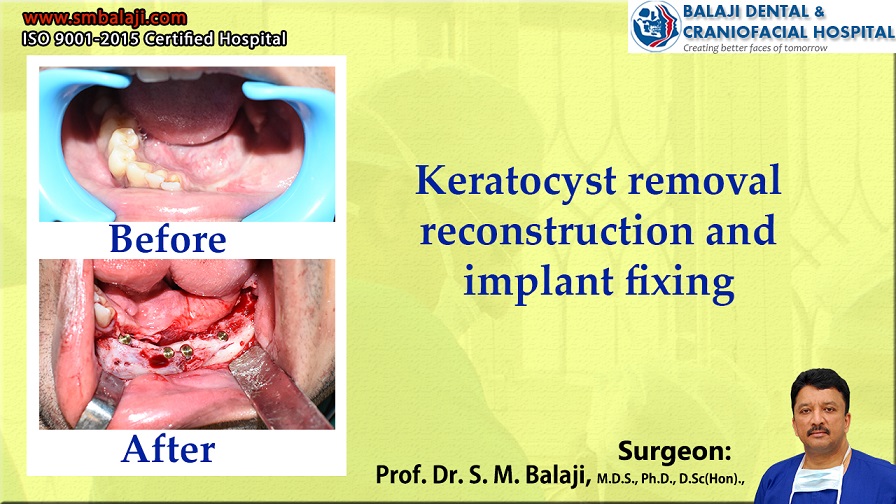
Keratocyst Removal, Reconstruction and Implant Fixing

Keratocyst Removal, Reconstruction and Implant Fixing

Development, Occurrence and Etiology of Odontogenic Keratocyst

Odontogenic keratocysts are benign developmental cysts, which cause extensive destruction of bone. The most commonly arise from the epithelial cell rests of the dental lamina. The most common affection region is the posterior region of the lower jaw. The presentation can be unilocular or multilocular in appearance.

These lesions have a preponderance for males and are most common in the 40-60 age group. Males are affected at a ratio of 2:1 when compared to females. They very rarely occur in the maxillary bone. There is localized pain and swelling at the site through the incidental radiographic diagnosis is common for this cyst. Gum tissue appearance is normal.

Treatment is through surgical resection of the lesion. The affected jawbone most often requires reconstruction as there is extensive destruction of bone by the lesion. It takes years of experience to gauge the amount of bone that needs to be removed during jaw cyst surgery. We have been addressing such lesions in our hospital for over 30 years now.

Voted the Best Jaw Reconstruction Hospital in India

Dr. SM Balaji, jaw cyst surgery specialist, has over three decades of extensive experience dealing with a variety of cysts. We have been recognized as the best jaw reconstruction hospital in India by our peers. This recognition has been achieved through consistent delivery of surgical excellence over the years.

We use a variety of modalities for performing jaw reconstruction. They include the utilization of grafts harvested from the patient. Consistent results and successful rehabilitation of patients have earned us the reputation of being the best jaw reconstruction hospital in India. We give importance to the establishment of overall oral health in our hospital.

Jaw reconstruction surgery is a specialty procedure performed at our hospital. Conditions such as open bite are addressed through surgery as well as orthodontic treatment in our hospital. We are a leading hospital for oral surgery in Chennai. We also have a well-equipped dental clinic in our hospital that addresses issues such as tooth decay.

Our hospital is a super specialty center for jaw cyst surgery and jaw reconstruction surgery. We have dealt with a wide variety of jaw lesions including dentigerous cysts, odontogenic keratocysts, ameloblastoma and various other conditions.

Our hospital is a leading center for orthognathic surgery in India. A recent pan Indian survey by a leading newspaper named us as the best jaw reconstruction hospital in India.

Patient Develops Swelling and Pain in the Lower Jaw

The patient is a 26-year-old male from Chalakudy in Kerala, India. He began noticing a slight swelling in the left lower jaw around a year ago. This began progressing further and he soon developed pain and tooth loosening at the site of the swelling. Alarmed over the events, he visited a local hospital.

Imaging studies and a biopsy were obtained at the hospital. Biopsy results came back positive with the diagnosis of odontogenic keratocyst in the left mandibular region. Treatment planning was explained to him and he consented to surgery.

The cyst was enucleated and the infected bone was debrided. There was a recurrence of the cyst in a few months and he underwent a second surgery. The second surgery was also unsuccessful with a resultant pathological fracture at the left parasymphyseal region.

He immediately presented again to his doctor in his hometown. Diagnostic studies were performed and revealed not only the fracture but also the recurrence of the lesion again. There was constant minor bleeding at the site of the surgery. Realizing the complexity of the presentation, they referred him to our hospital for management.

Initial Presentation at our Hospital for Surgical Management

Dr. SM Balaji, jaw cyst surgery specialist, examined the patient and obtained imaging studies. This demonstrated that there was a recurrence of the lesion along with a pathological fracture of the mandible. He explained that the patient needed to undergo removal of the recurrent lesion. This would be followed by jaw reconstruction surgery and subsequently by dental implant surgery.

This line of treatment would result in complete rehabilitation for the patient with the restoration of complete normalcy. The patient was in full agreement with the treatment plan and consented to surgery.

Surgical Resection of the Recurrent Odontogenic Keratocyst

Under general anesthesia, rib grafts were harvested from the patient to be utilized for jaw reconstruction. A Valsalva maneuver was performed to ensure that there was no perforation into the thoracic cavity. The incision was then closed in layers with sutures.

Attention was next turned to the odontogenic keratocyst. The patient’s recurrent lesion was resected in its entirety. The bone was debrided to reveal the fresh healthy bone. Harvested rib grafts were carefully crafted to fit into the bony defect in the mandible.

There was good recreation of bony anatomy at the site of the bony defect. The bone grafts were then fixed to the mandibular bone with titanium screws.

Patient Returns in Four Months for Dental Implant Surgery

As instructed at the time of previous surgery, the patient returned in four months for dental implant surgery. Imaging studies revealed complete consolidation of the bone grafts with underlying mandibular bone. The long-term prognosis for this patient is very good.

There was a reestablishment of a good mandibular contour at the site of the surgery. The titanium screws that were used to fix the grafts were removed. This was then followed by the fixation of premium dental implants to the alveolar bone. Removable dentures are a poor substitute for dental implants.

The patient was instructed to return in six months for fixation of ceramic crowns to the dental implants. These replacement teeth (artificial teeth) will be perfectly shade-matched to his natural teeth. This period would allow for complete osseointegration of the implants with the alveolar bone.

The patient expressed understanding of the instructions and expressed his happiness at the standard of care in our hospital.

Surgery Video


Dental Implant Procedures for Oral Rehabilitation

Dental Implant Procedures for Oral Rehabilitation

[dsm_gradient_text _builder_version=”4.9.10″ _module_preset=”default” gradient_text=”What is Dental Implant Surgery?” hover_enabled=”0″ sticky_enabled=”0″][/dsm_gradient_text]

Dental implant surgery is performed to place root-shaped titanium posts at the site of missing teeth. This titanium implant fuses with a surrounding bone through a process known as osseointegration. This then provides the perfect foundation for fixing ceramic crowns. They fulfill every criterion for being a perfect replacement for lost teeth.

Dental implant procedures have become one of the most common procedures performed in dental clinics today. A high percentage of patients with missing teeth choose to undergo dental implant procedures. Most single-tooth procedures are performed at the chairside under local anesthesia.

[dsm_gradient_text _builder_version=”4.9.10″ _module_preset=”default” gradient_text=”Patient Preparation for Dental Implant Procedure” hover_enabled=”0″ sticky_enabled=”0″][/dsm_gradient_text]

Chairside dental implant procedures are relatively simple surgeries. It is performed under local anesthesia. Conscious sedation is used in patients who are apprehensive of undergoing dental implant surgery. Patients are advised to not consume anything orally for four hours before the scheduled surgery.

Conscious sedation is easily administered to the patient. A patient who is scheduled to undergo conscious sedation has to bring an attendant with them. The effect of conscious sedation wears off within a few hours following the procedure. Conscious sedation is completely safe and the patient is monitored throughout the procedure.

[dsm_gradient_text _builder_version=”4.9.10″ _module_preset=”default” gradient_text=”Selection of Candidates for Dental Implant Surgery” hover_enabled=”0″ sticky_enabled=”0″][/dsm_gradient_text]

Anyone who is healthy can undergo dental implant procedures. Patients first undergo a full mouth examination including diagnostic imaging studies. A thorough medical history is also obtained. This will ensure complete patient safety for undergoing the procedure.

Blood pressure and blood sugar status are determined through tests. Overall oral health is assessed. Any sign of minor bleeding from gums is tested. The health of the gum tissue is also assessed. Any residual tooth roots need to be removed. A thorough check is conducted for every type of dental condition.

Dental implant surgery is straightforward when there is an adequate bony foundation for the fixation of the implants. This is performed as a procedure in the dental clinic under local anesthesia. A period of 4-6 months is allowed to elapse to allow for osseointegration of the implant.

Abutments are connectors that are used to connect the crowns to the dental implants. Ceramic crowns are attached to the abutments, thus providing a permanent replacement for the missing teeth. Patients need to maintain good oral hygiene to enjoy a lifetime of trouble-free service from their dental implants.

[dsm_gradient_text _builder_version=”4.9.10″ _module_preset=”default” gradient_text=”Additional Surgeries for Enabling Fixation of Dental Implants” hover_enabled=”0″ sticky_enabled=”0″][/dsm_gradient_text]

Patients sometimes do not have enough bone in their jaws for the fixation of dental implants. This could either be due to tooth loss a long time ago or surgery for jaw diseases. Modern surgical techniques overcome these obstacles and enable dental implant procedures for these patients.

[dsm_gradient_text _builder_version=”4.9.10″ _module_preset=”default” gradient_text=”Bone Grafting in Jaws to Enable Placement of Dental Implants” hover_enabled=”0″ sticky_enabled=”0″][/dsm_gradient_text]

Bone grafting is commonly used to improve the bony foundation in the jaws to enable the placement of the titanium posts. This is harvested from the patient at the time of placement of implants. Results from this surgery are very good and there is complete normalization of function after placement of dental implants.

This procedure is performed in the operating theatre under general anesthesia. Patients need to be admitted to the hospital the day before surgery. They also should not consume anything orally for at least eight hours prior to surgery. This requires hospitalization for approximately three days.

[dsm_gradient_text _builder_version=”4.9.10″ _module_preset=”default” gradient_text=”Sinus Lift Surgery in the Posterior Region of the Upper Jaw” hover_enabled=”0″ sticky_enabled=”0″][/dsm_gradient_text]

Bone is lost quickly in the posterior region of the upper jaw after loss of the molar teeth. The size of the maxillary sinus also increases when teeth are lost in the upper molar region. This results in the inadequate bony foundation for the placement of the titanium implants.

Sinus lift surgery is performed in patients with such a presentation. A bony window is made in the posterior region of the upper jaw. The membrane lining the maxillary sinus is first gently lifted. Bone graft or bone substitute is placed in the space created between the lining and the bone. Dental implants are then placed in this region.

This results in good bony consolidation in the region with adequate support for the implants. Results are very good for patients who undergo this procedure.

[dsm_gradient_text _builder_version=”4.9.10″ _module_preset=”default” gradient_text=”Placement of Zygoma Implants to avoid Bone Grafting” hover_enabled=”0″ sticky_enabled=”0″][/dsm_gradient_text]

Zygoma implants are the ideal implants for patients who do not wish to undergo bone graft surgery. These are extra long implants, which are placed directly in the zygomatic bone. This is a very strong bone, which enables these implants to withstand high biting forces.

[dsm_gradient_text _builder_version=”4.9.10″ _module_preset=”default” gradient_text=”Choice of Artificial Teeth for Dental Implants” hover_enabled=”0″ sticky_enabled=”0″][/dsm_gradient_text]

Dental implant procedures can either involve the placement of implants to replace one to all teeth. It can range from a few missing teeth to full mouth replacement. Crowns that are cemented in place are the treatment of choice for single teeth implants or replacement of short spans.

Complete dentures placed over implants can either be removable or fixed. Removable dentures mimic normal gum and teeth structure and can be snapped into place. Fixed dentures again are cemented into place and cannot be removed by the patient

[dsm_gradient_text _builder_version=”4.9.10″ _module_preset=”default” gradient_text=”What to Expect After Dental Implant Surgery” hover_enabled=”0″ sticky_enabled=”0″][/dsm_gradient_text]

As with all surgical procedures, these procedures are followed by side effects like swelling and pain at the site of the procedure. The dental specialist addresses these issues. This is easily controlled with analgesics and quickly subsides in a few days. The patient can resume normal activity in a very short period of time.

[dsm_gradient_text _builder_version=”4.9.10″ _module_preset=”default” gradient_text=”Long Term Care after Dental Implant Procedure” hover_enabled=”0″ sticky_enabled=”0″][/dsm_gradient_text]

Dental implants require the same level of care that is provided to natural teeth. Meticulous oral hygiene has to be maintained to ensure the long-term success of dental implants. The patient should schedule a dental checkup every six months for follow-up care. This will ensure that the patient has trouble-free service from their dental implants all their life.


Odontoma Nerve Compression Removal and Reconstruction

Odontoma Nerve Compression Removal and Reconstruction

What is an Odontome and how is it formed?

An odontome is a benign tumor, which is linked to the abnormal development of a tooth. It is a hamartoma and is composed of irregularly placed normal tissue. This can involve both hard tissue as well as soft tissue. Odontoma was the previously used terminology for an odontome.

Most Frequently Diagnosed Age Group for Odontome

This condition is most commonly diagnosed during the early teenage years. It is most commonly incidentally diagnosed when there is a delayed eruption of a tooth. Odontomes are frequently associated with unerupted teeth. They are rare instances of eruption into the oral cavity.

Extraction of the unerupted odontome is the usual treatment of choice. This is akin to surgical removal of impacted third molars. Impacted mandibular odontomes are usually found deeper in the jawbone, being in close proximity to the inferior alveolar nerve. An improper surgical technique can lead to damage to the nerve.

Successful extraction of an impacted mandibular odontome requires a lot of experience. The best possible results are obtained by surgery performed by experienced oral and maxillofacial surgeons. Oral surgery is one of the specialties of dentistry. Our dental clinic in Chennai is a premiere center for oral surgery.

Hard Earned Reputation as the Best Wisdom Tooth Hospital In Chennai

Dr. SM Balaji, Oral and Maxillofacial Surgeon, has over three decades of experience in dealing with the extraction of impacted teeth. Our hospital is considered to be the best wisdom tooth surgery hospital in Chennai. We perform chair-side wisdom tooth surgery for simple cases. Extraction of complicated impacted wisdom teeth is performed in the operation theatre under general anesthesia.

Our expertise in ensuring the best possible surgical results for patients is hard-earned. This has earned us the title of best wisdom tooth surgery hospital in Chennai from both our peers and patients alike. We handle the most complicated cases of impacted wisdom teeth. They even present near the lower border of the mandible as well as near the orbital cavity.

We have been named the best wisdom tooth surgery hospital in Chennai by a recent survey by a leading newspaper. The survey has also named us as being the best wisdom tooth surgery hospital in India. This high honor has been made possible by our commitment to excellence and ensuring total patient satisfaction.

Best Tooth Extraction Hospital in Chennai

Our hospital is amongst the leading dental hospitals in India. We are the destination of choice for the best dental treatment in Chennai. Many patients come from around the world for dental treatment at our hospital.

Our hospital is equipped with the latest technological advancements to offer the best possible treatment for our patients. The dental services provided by our hospital are amongst the best in the entire nation. We are a tertiary centre for specialized world-class dental care in India.

Patient Presents to our Hospital for Definitive Treatment of Odontome

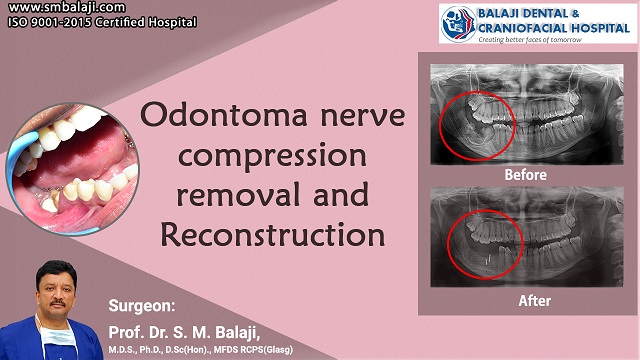
The following case is a description of a patient who came to our hospital for treatment of an odontome. There was also compression of the inferior alveolar nerve by the odontome. The odontome was extracted with minimum trauma along with an associated impacted tooth. There was no compromise of nerve function following the surgery.

Failure of Initial Treatment Elsewhere for the Patient

The patient is a 25-year-old female from Gingee in Tamil Nadu, India. Around 18 months ago, she had presented at a local hospital with pain and mild swelling in her mouth. This was at the site of a missing first molar tooth on the right side of her lower jaw. Imaging studies had been obtained, which revealed an impacted first molar and a partially formed second molar.

There was a radiopaque shadow around the second molar. The second molar tooth was in close proximity to the inferior alveolar nerve. This was diagnosed as an odontome and extraction were recommended to the patient. However, the attempt to extract the two teeth was abandoned midway with the removal of the crown of the impacted first molar. There was no occurrence of a dry socket.

The patient was advised to seek treatment at a superspecialty center, but failed to do so. It was only 18 months later that the patient presented to our hospital. The swelling and pain with paresthesia at the site of the attempted extraction forced her to address this.

Initial Presentation and Treatment Planning at our Hospital

Dr. SM Balaji, Wisdom Tooth Impaction Surgeon, examined the patient and ordered imaging studies. This revealed the first molar with the missing crown and partially formed the second molar. The second molar was diagnosed as an odontome.

There was also a draining sinus at the site of the attempted extraction. Compression of the nerve by the odontome was diagnosed as the cause for her paraesthesia. Treatment planning was explained to the patient and her attendants in detail. She expressed understanding and consented to undergo surgical removal of the impacted teeth.

The patient was taken to the operating room and anesthesia was induced. Prepping and draping were done to have the wisdom tooth removed. Tooth removal was preceded by an incision of the gum tissue overlying the region. The impacted wisdom tooth was then exposed following removal of overlying bone.

Both teeth were then extracted followed by debridement of granulation tissue at the site. There was a complete resolution of the patient’s complaints following surgery. A rib bone graft harvested at the time of surgery was used to reconstruct the bony defect at the surgical site. This was fixed with titanium screws.

Postoperative instructions were given to the patient. She will return in six months following complete consolidation of the bone graft with surrounding alveolar bone. Dental implant surgery would be performed at that time with the placement of premium dental implants. Ceramic crowns would be fixed to the dental implants following osseointegration of the implants to the mandibular bone.

The patient was very happy with the level of care at our hospital. She also expressed a complete understanding of the instructions given by hospital staff before discharge from the hospital.

Surgery Video


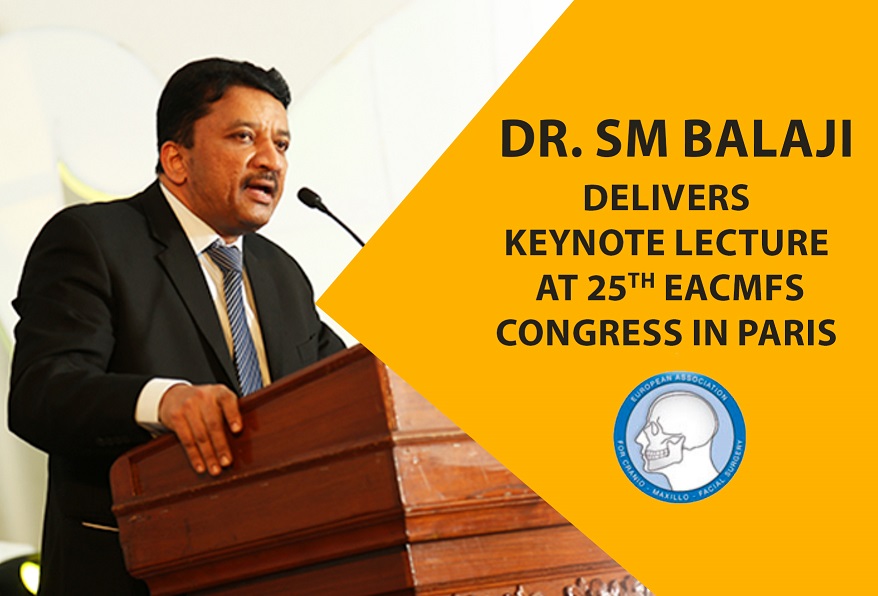
Dr. SM Balaji Delivers Keynote Lecture at 25th EACMFS Congress in Paris

Dr. SM Balaji Delivers Keynote Lecture at 25th EACMFS Congress in Paris

Dr. SM Balaji was invited to EACMFS 2021 for the Craniofacial Surgery Lecture

The 25th European Association for Craniomaxillofacial Surgery (EACMFS) Congress was held in Paris, France from July 14-16, 2021. The ongoing COVID-19 pandemic made the physical congress impossible this year. It was therefore held online for the first time. There was the participation of a record number of delegates from around the world.

Stalwarts from the field of Craniomaxillofacial Surgery were invited as speakers to deliver lectures at the plenary session of the congress. Dr. SM Balaji is a leading Craniomaxillofacial surgeon with many surgical innovations to his credit. He was invited by Prof Jean-Paul Meningaud, EACMFS 2021 Congress Chairman for a Craniofacial Surgery lecture at the plenary session.

The genesis of the European Association for Craniomaxillofacial Surgery

The European Association for Craniomaxillofacial Surgery was established in 1970. It is a preeminent association of craniomaxillofacial surgeons, which was formed to advance the surgical superspecialty. The EACMFS Congress has always been a platform for leading surgeons to share the latest advances in the field.

Many specialists from oral and maxillofacial surgery also register as delegates for the conference. They also perform plastic and reconstructive surgeries. Plastic surgery is performed by many oral surgeons. There were many oral and maxillofacial surgery lectures at the congress.

The oral and maxillofacial surgery presentations were greatly appreciated by the delegates. These were delivered by leading oral and maxillofacial surgeons from around the world.

Oral and Maxillofacial Surgery Masterclasses by Eminent Surgeons

The oral and maxillofacial surgery masterclasses by leading surgeons provide a great learning platform for the participants. Craniofacial surgery masterclasses focus on complex craniofacial reconstructions in a variety of conditions. The oral and maxillofacial surgery lectures present groundbreaking research findings at these congresses.

Invitations to Leading Craniomaxillofacial Surgeons as Plenary Session Speakers

Leading craniofacial surgeons from around the world are invited as speakers at the plenary sessions of the conference. The invited speakers delivered expert oral and maxillofacial lectures at the congress. This serves as an ideal platform to update on the latest advances made around the world.

The EACMFS Congress plays host to over 3000 delegates who converge on the venue from around the globe. Craniomaxillofacial surgeons from around the world deliver cutting-edge research findings at the plenary sessions. Congress serves as a platform for everyone to catch up and renew professional and personal relationships.

25th EACMFS Congress held Online due to the Ongoing COVID-19 Pandemic

The last two years however have been unprecedented due to the COVID-19 pandemic, which has played havoc around the world. COVID-19 cases have seen a lot of fatalities as well as residual comorbidities.

The Ministry of Health of the Government of India has played a leading role in the control of the pandemic. It has drawn stringent guidelines for international travel to prevent the spread of the virus. Public health studies have helped in the control of the virus.

After due deliberation, it was decided to conduct the 25th EACMFS 2021 in Paris entirely online. The EACMFS 2021 congress has seen the registration of even higher numbers of delegates than usual.

Dr. SM Balaji Delivers Oral and Maxillofacial Surgery Presentation at Congress

Dr. SM Balaji has delivered successful plenary session lectures at previous EACMFS conferences. He was also invited to deliver a lecture at the EACMFS 2021 plenary session. The topic chosen by him was the management of secondary orbital deformities caused by fractures and soft tissue trauma.

This was both an oral and maxillofacial surgery lecture as well as a craniofacial surgery masterclass. He is a specialist in orthognathic surgery, surgical removal of impactions with tooth extraction, cleft lip and palate surgery and temporomandibular joint surgeries.

Craniofacial Surgery Masterclass on Management of Secondary Orbital Deformities

Fractures of the orbital cavity are on the rise around the world. They are caused most commonly by road traffic accidents and falls. Other causes include assaults and sports-related injuries. The number of cases with secondary orbital deformities after surgeries is also on the rise.

Dr. SM Balaji chose this topic for his plenary session lecture at the EACMFS 2021 Congress. He has handled a wide variety of patients with postoperative complications of orbital fractures. These include cases with gunshot injuries, multiple fractures caused by road traffic accidents and sports-related injuries.

Appreciation of Craniofacial Surgery Lecture at Plenary Session by Delegates

Dr. SM Balaji began his lecture by explaining the alignment of bones in the orbital cavity. He then explained the importance of the reestablishment of correct alignment following surgery. This was followed by enumerating the complications that would arise by improper reduction of the bones.

The presentation next included a wide variety of patients with secondary orbital deformities. He enumerated the various techniques that can be adopted for the surgical management of individual cases. Materials used for the reconstruction of defects were presented in detail. Rehabilitation of the patient back to complete normalcy was documented at the end of the presentation.

Dr. SM Balaji’s lecture was widely appreciated by the delegates. It showcased the important role played by Craniomaxillofacial surgeons in the rehabilitation of victims of craniofacial trauma.

Successful Conclusion to 25th EACMFS Congress in Paris, France

The EAFMFS Congress held in Paris, France saw a record number of delegates. Presentations at the plenary session provided significant research findings from around the world. Innovations to improve results were presented at the congress.

Prof. Jean-Paul Meningaud thanked the speakers at the plenary session for their excellent presentations at the EACMFS conference. He also invited all delegates to the 26th European Association for Craniomaxillofacial Surgery Congress. This is scheduled to be held next year in Madrid, Spain.

Surgery Video