Warning: Constant WP_CACHE already defined in /home/smbalnoi/backup.drsmbalaji.com/wp-config.php on line 86

Warning: The magic method Vc_Manager::__wakeup() must have public visibility in /home/smbalnoi/backup.drsmbalaji.com/wp-content/plugins/js_composer/include/classes/core/class-vc-manager.php on line 203
Surgery – Page 5 – Balaji Dental and Craniofacial Hospital, Chennai, India
Jaw Joint Fracture – TMJ Surgery

Jaw Joint Fracture – TMJ Surgery

What is Jaw Joint Fracture (Temporomandibular Joint (TMJ) fracture)

Jaw Joint Fracture or temporomandibular joint (TMJ) factor occurs when the mandible and/or temporal bone is broken near or through the TMJ, the joint linking the jaw bone to the skull. Like other bones in the body, the mandible, also known as the jaw bone, and the temporal bone, the bone on the skull that forms the upper part of the jaw joint, can break when trauma occurs. Fractures of TMJ arise due to direct trauma to the face. The jaw splits most frequently around the condyles, which are rounded projections of the jaw bone. The fracture can also occur when the joints are dislocated.

Young Boy suffers Jaw Injury from Fall at Home

The patient is an 11-year-old boy from Chennai in Tamil Nadu, India. He tripped and fell while playing with friends a few hours ago. His lower jaw hit the ground and he complained of inability to open his mouth fully. There was also mild bleeding from a lower lip laceration.

His parents noticed a deviation of his jaw to the left side upon mouth opening. There was also a grating noise from the left jaw joint. He also complained of facial pain on the left side. There was radiation of pain from his jaw joint to the rest of the face.

Development of facial asymmetry is a feature found in all fractures of the jaws. Movement of the jaw results in worsening of the pain.

Initial Consultation at our Hospital for Management

Fearing that he had a fracture, his parents rushed him to our hospital. Our hospital is a leading center for jaw fracture surgery in India. We are a specialty treatment center for jaw joint fractures.

Our hospital has introduced various innovations related to jaw surgery. These innovations are standard operating procedures in many parts of the world today.

Features of Jaw Surgeries Performed at our Hospital.

Various conditions of the jaws are addressed at our hospital. Jaw reduction surgery and jaw augmentation surgery are also performed at our hospital. Upper jaw augmentation is commonly through Le Fort I maxillary osteotomy.

Lower jaw augmentation is through distraction osteogenesis. Jaw reconstruction is also performed for lesions like tumors and cysts. Our hospital specializes in all types of TMJ surgery. Bone grafts harvested from the patient aid in the reconstruction of jaw deformities. These are most commonly harvested from the ribs and iliac crest.

All these surgeries are performed under general anesthesia. Joint reduction surgery is performed after ensuring all safety precautions. Special safety features have been added in view of the COVID-19 pandemic.

Lower jaw fractures are amongst the most common fractures. Common causes are accidents and assaults. The lower jaw most commonly strikes the ground first when there is a fall. Upper jaw fractures are more associated with assaults and road traffic accidents. They rarely occur from falls.

Children constitute a high proportion of patients with jaw fractures. This is due to their very active lifestyle and physical activity.

Forces are transmitted from the chin to the jaw joint. The chin and the jaw joint are the most common sites for lower jaw fracture.

This can be treated by either open reduction or closed reduction. Closed reduction is utilized in children and in the case of favorable fractures. Open reduction is the preferred choice of treatment in more complex presentations.

Examination and Treatment Planning for the Patient

Dr. SM Balaji, facial cosmetic surgeon, examined the patient and obtained imaging studies. Lower lip laceration was sutured and a diagnosis of left temporomandibular joint condylar fracture was made. There was a medial displacement of the fractured condyle.

This presentation necessitated plate fixation for fracture stabilization. Treatment planning was explained to the parents and they consented to surgery.

Successful Reduction and Fixation of Condylar Fracture

The fracture site was approached through a modified Alkayat-Bramley incision using an endaural approach. The fractured condylar segment was visualized and stabilized using plate and screws. Extreme care was taken to ensure the safety of the facial nerve. There will be no visible scar tissue from the surgery.

Movement of the mandible after plate fixation demonstrated good fracture reduction. The patient recovered without an event from the surgery. He demonstrated good facial nerve function and there were no deficits. He opened his eyes and closed them forcefully as well as demonstrated normal mouth opening.

They were very happy with the level of care at our hospital and expressed total satisfaction. He and his parents thanked the hospital staff before final discharge from the hospital.
Surgery Video – Jaw Joint Fracture Surgery


Fronto orbital Complex Fracture Surgery (Eye level Correction)

Fronto orbital Complex Fracture Surgery (Eye level Correction)

Patient Involved in Road Traffic Accident in his Hometown

The patient is a 46-year-old man from Ajmer in Rajasthan, India. He had been injured in a multi-vehicle road accident around six months ago. There was a direct impact on the left side of his face from a vehicular bonnet.

He had suffered multiple fractures to the bones of the left upper and middle face. Orbital blowout fractures are common in such accidents. There were also serious soft tissue injuries.

Failed Surgery at a Multispecialty Hospital

He had been rushed to a multispecialty hospital in a nearby town for emergent care and treatment. This had been followed by a series of surgeries to correct his deformities. All these surgeries failed and he was left with a gross left-sided facial deformity. There was also malocclusion from the failed surgeries.

Feeling very frustrated, he had approached an organization for help to address this. Having referred patients to us before for facial cosmetic surgery, they sent him to us. They contacted our hospital manager and set up an appointment for him.

Our hospital is a specialty center for redo facial trauma surgery of failed surgeries performed elsewhere. Board-certified plastic and reconstructive surgeons perform such complex surgeries in Western nations. We rehabilitate patients who need complex head and neck surgery

Initial Presentation at our Hospital for Redo Facial Trauma Surgery

Dr. SM Balaji, facial reconstruction surgeon, examined him and obtained a detailed history. A 3D CT scan revealed malunion of his facial fractures from botched surgery. There was malpositioning of the medial wall of orbit fracture.

He also had malunion of his frontozygomatic and front orbital fractures. His left frontal bone had a depressed fracture. Extraocular muscle movement was hampered by the circumorbital fractures.

Multiple Fractures of the Left Facial Region

There was also a blowout fracture of the left floor of the orbit. This had resulted in the lowering of his left orbital contents in relation to the right. A poorly positioned mesh was visualized over his left frontal bone. Malunion of his zygomaticomaxillary fracture had resulted in severe malocclusion.

His speech was also affected by his condition. It was explained to him that all the old plates needed to be removed. The malunited fractures had to be refractured and replated in the correct anatomical position. The patient was in agreement with the plan and consented to surgery.

Refracture of Multiple Malunited Fractures from Previous Surgeries

Access was gained to the left forehead fracture site through the old incision. Plates from previous surgeries were removed. There was a very poor reduction of the front orbital and frontozygomatic fractures.

Resetting Fracture Segments in Correct Anatomical Position

Fracture segments were aligned in normal anatomical positions. The old mesh was also removed. Granulation tissue was excised from the region and bone smoothened with a bur. The old plates from the zygomaticomaxillary fracture fixation were removed.

Occlusion was adjusted and the fracture fragments were stabilized with plates. His old zygomatic arch fracture was also stabilized with plates and screws. It had been unstable after the previous surgery.

This was then followed by a subciliary incision. Access was gained to the orbital floor blowout fracture site. Entrapped orbital contents were released. The medial wall of orbit fracture was addressed next. The detached canthal ligament was reattached with a Y-plate canthopexy. This resulted in a good correction of the fracture.

Next, a titanium mesh with Medpor was used to repair the orbital floor fracture. This resulted in eye-level correction for the patient. A new mesh was then placed over the depressed frontal bone fracture.

Total Patient Satisfaction with Results of Surgery

The surgery resulted in improved facial esthetics as well as functional improvements. The patient tolerated the procedure well. He expressed his gratitude to the surgical team before discharge from the hospital.

Surgery Video


Pierre Robin Syndrome – Lip Adhesion Release Surgery

Pierre Robin Syndrome – Lip Adhesion Release Surgery

What is Pierre Robin Syndrome?

Pierre Robin syndrome is a disorder in which an infant has a smaller than normal lower jaw, a tongue that falls back in the throat, and breathing difficulties.

Causes

The exact causes of the Pierre Robin Syndrome are unknown. It is likely a part of a variety of genetic syndromes.

The lower jaw grows slowly before birth but can grow faster in the first few years of life.

Symptoms

Symptoms of this condition include:

  • Cleft palate
  • High-arched palate
  • Jaw that is very small with a small chin
  • Jaw that is far back in the throat
  • Repeated ear infections
  • Small opening in the roof of the mouth, which may cause choking or liquids coming back out through the nose
  • Teeth that appear when the baby is born
  • Tongue that is large compared to the jaw

Patient Returns for Tongue Lip Adhesion Reversal

This 10-month-old boy is from Chennai in Tamil Nadu, India. He was born with the classical signs of Pierre Robin syndrome. There were micrognathia, retruded tongue and cleft palate. Children with cleft palate have a hole in the roof of the mouth. His parents presented to our hospital for management of his birth deformities.

Treatment planning was first explained to the parents. They understood each surgery had to follow the planned schedule for the best results. Parents consented to the proposed treatment plan. Plastic surgeons also perform this surgery in countries like Japan and the US.

Retruded tongue position and micrognathia cause the tongue to fall into the throat. This would result in airway blockage by the tongue. He underwent tongue lip adhesion surgery a day after the presentation at our hospital. This surgery prevents the occurrence of stridor in Pierre Robin afflicted infants.

Characteristics of Airway Obstruction by Tongue

Stridor is the high-pitched breath sound arising from an obstructed airway. Infants with Pierre Robin sequence run the risk of airway obstruction by the tongue. Tongue lip adhesion surgery prevents this potential threat to the life of the infant.

Pierre Robin syndrome can develop from an abnormal intrauterine fetal neck position. Flexion of the developing mandible against the sternoclavicular joint can result in micrognathia. This could cause abnormal retrusion of the tongue.

The tongue pushes up against the developing palate causing nonfusion of the palate. This syndrome can also have a genetic basis for its development.

Specialty Center for Management of Cleft Deformities

Dr. SM Balaji, Oral and Maxillofacial Surgeon, has over 30 years of surgical experience. This includes cleft lip and palate surgery and craniofacial deformity surgery amongst others. Our hospital is also a specialty center for facial cosmetic surgery.

Many celebrities have undergone cosmetic nose surgery at our hospital. We are also a specialty trauma care center for facial fracture surgery. Our hospital also has a 24-hour ambulance service for facial trauma victims.

Our hospital is the Southeast Asian affiliate of the Dallas-based World Craniofacial Foundation. Students from Western dental schools request our hospital for observership opportunities. Many children with syndromic deformities get a new lease of life at our hospital.

Patients from all over the world come to our hospital to undergo corrective surgery. These include patients from developed regions like Europe, Japan and the US.

We have two dedicated states of art operating theaters in our hospital. Our nursing staff has over 20 years of experience in providing quality postoperative care. The lives of many afflicted children have undergone transformation here.

Cleft Palate Surgery followed by Tongue Release

The patient underwent cleft palate repair at 10 months old. A positive suction test denoted that there was optimal surgical correction.

He then underwent reversal of the tongue lip adhesion in two days. Delay of this surgery would lead to abnormal speech development. There was an uneventful recovery from both surgeries.

He was very lively and vocal throughout his postoperative stay. Tongue movement demonstrated the full range of motion. His parents were very happy with the results of the surgery. They expressed their gratitude to the hospital staff before final discharge.

Surgery Video


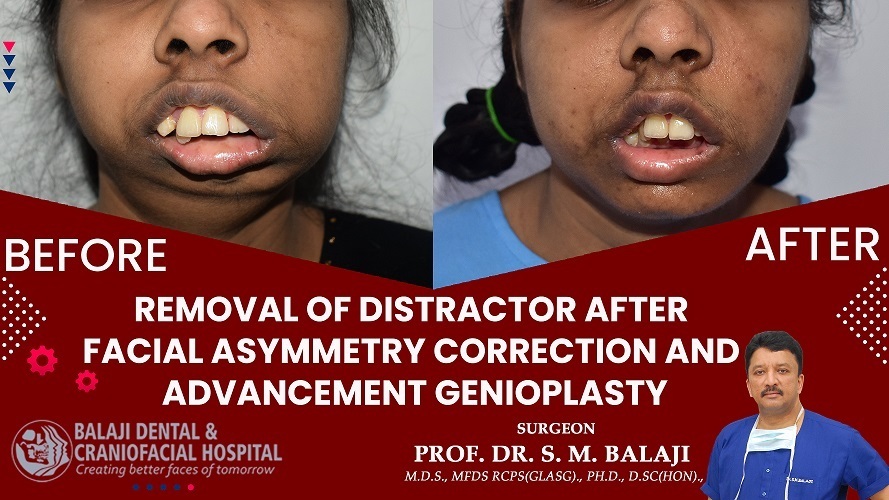
Removal of Distractor after Facial Asymmetry Correction and Advancement Genioplasty

Removal of Distractor after Facial Asymmetry Correction and Advancement Genioplasty

Young Girl with Progressive Development of Facial Deformity

This 24-year-old girl from Malappuram in Kerala suffered an injury to her jaw as a child. Her parents did not present her to a doctor as the pain subsided within two days. They soon began noticing a developing jaw deviation to the left as time passed.

This worsened to the point where people began commenting on it. All the negative attention affected her social life. She also began complaining of difficulty with eating and speech.

Failure of Initial Surgical Correction in her Hometown

Realizing that she needed treatment, they presented to a surgeon in their hometown. He recommended surgical correction of her diagnosis of unilateral TMJ ankylosis. She had undergone surgery, which was a failure. There was also altered taste sensation after the surgery.

Despairing at the turn of events, her parents had sought the help of a family friend. Being a medical professional, she had made inquiries into the best treatment facility. She then referred them to us as our hospital is a specialty TMJ treatment center.

Center of Excellence in Oral and Maxillofacial Surgery

Our hospital is a premiere center for facial deformity correction. We are an international center for cleft lip surgery and cleft palate surgery. Children with clefts find a new lease of life at our hospital. There is a hole in the roof of the mouth in cleft palate children.

Our hospital boasts of a state of art facial trauma surgery unit. Syndromic craniofacial deformity correction offers a new lease of life to many patients. Autologous bone grafts are a vital component for such surgeries.

Plastic surgeons also perform cleft lip and palate repair in Western nations. Cleft lip repair is always performed at 3 months of age for best results. Such patients need speech therapy if they develop speech problems.

Treatment Planning Explained in Detail to Patient and Parents

Dr SM Balaji, TMJ Ankylosis Surgeon, examined her and obtained imaging studies. She had a pronounced jaw deviation to the left with a skewed occlusal cant. He explained to them that the altered taste sensation was due to nerve damage.

The previous surgery was a failure on all fronts. Left TMJ ankylosis was still very much present. This would also need corrective surgery at our hospital. We are a specialist center for TMJ surgery.

Anesthesia would be through bronchoscopic intubation because she had minimal mouth opening. The first step of her rehabilitation would involve gap arthroplasty of her ankylosed joint. This would involve interpositioning of temporalis muscle to prevent relapse.

The next step would be distraction osteogenesis of her mandible and Le Fort I of her maxilla. This would correct her jaw deformity and skewed occlusal cant. Advancement genioplasty was also planned along with this.

There would be no chin implants in this case. Soft tissue profile would improve with this surgery. A retruded chin detracts from the structure of the chin.

She underwent successful completion of the first two steps of her surgical correction. Ankylosis release resulted in good movement of her mandible. Distraction of 12 mm performed at a rate of 1 mm a day corrected her jaw deformity.

Chin advancement surgery resulted in great improvement to her facial esthetics. They were then advised to return in four months for distractor removal.

Distractor Removal after Successful Resolution of Complaints

They returned for distractor removal during the ongoing COVID-19 pandemic. Our hospital has always prided itself on giving prime importance to patient safety. Latest technology for safety instilled in the hospital ensured zero risks for everyone.

HEPA air filters installed in the Operation Theater ensured filtration of virus particles. Ultraviolet germicidal irradiation was also utilized during downtime from surgery. Routine testing administered to all personnel was also made operational norm.

Imaging studies obtained revealed good consolidation of new bone at the distracted site. The distractor was then removed. She had good occlusion along with correction of her skewed occlusal cant. Fixed orthodontic treatment would ensure complete correction of her dental malalignment.

She and her parents expressed their gratitude to the surgical team. They said that she felt like a new person following the surgical jaw correction.

Surgery Video


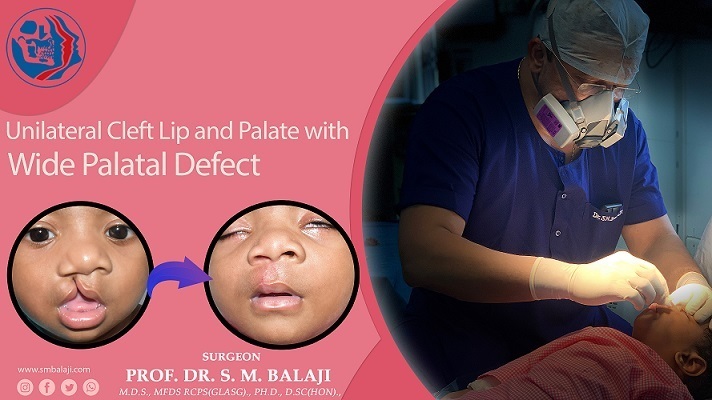
Unilateral Cleft Lip and Palate Deformity

Unilateral Cleft Lip and Palate Deformity

Little Boy born with Cleft Lip and Palate Deformity

This little boy is from Gwalior in Madhya Pradesh, India. He was born with a unilateral cleft lip and palate deformity. There were no other craniofacial defects associated with it. He had a split upper lip. There was a hole in the roof of the mouth.

This palatal defect was very wide. His parents required counseling at the hospital as they were very upset. The counselors explained that their child would get to lead a normal life with surgery. Parents were then informed on what to expect during the process of rehabilitation. This helped them accept the situation and plan ahead.

Types of Cleft Deformities in Children

There are many varieties of cleft deformities in children. They can range from the horrific facial clefts to simple cleft lip. Cleft lip is the most common birth defect in children. Plastic surgeons also perform cleft lip and palate correction.

Correct Time Schedule for Cleft Repair Surgeries

They were also informed about the timeline of required corrective surgeries. Cleft lip surgery is at 3 months and cleft palate repair is at 11 months. Bone grafting for alveolar cleft surgery is at 3-1/2 years of age.

Referral to our Hospital for Cleft Correction

Once the parents accepted the situation, they were then referred to us for surgery. Scores of children have undergone cleft repair with us over the last three decades. Many of them are now married with children of their own. Our hospital has even operated on some children born with the same defect to these parents.

We are a referral centre for cleft and craniofacial deformity in Southeast Asia. Many international organisations refer cleft patients to us. We are the Southeast Asian affiliate for the World Craniofacial Foundation, USA.

Our Cleft Lip and Palate Research Unit has many innovations to its credit. These surgical innovations are standard practices around the world today.

Oral and Maxillofacial Surgery Specialty Hospital

Our hospital has a dedicated facial cosmetic surgery unit. The facial trauma surgery unit is also a part of this unit. We are a tertiary care unit for patients with traumatic facial disfigurement. Many overseas patients also find a new lease of life with us.

Initial Presentation and Examination at our Hospital

Dr SM Balaji, Cleft Lip Surgeon, examined the patient in detail. He had a unilateral cleft lip and palate with a wide palatal defect. He explained the surgical procedure in detail to the parents. They agreed to the treatment plan and signed the consent.

Special Pandemic Related Precautions Adopted

Patient and theater personnel safety was paramount as this was at the height of the pandemic. New ventilatory systems ensured constant flow of fresh oxygenated air into the theater. Special filters ensured safe environs for successful surgical outcome.

Surgical Correction of Cleft Lip Deformity

He decided to perform the modified Millard’s technique. The floor of the nose and nasal sill were first reconstructed using a C-flap. This was then followed by reapproximation of his vermillion border.

There was meticulous reapproximation of the cleft lip with a three layer closure. The three layers included the orbicularis oris, subcutaneous tissue and skin. Use of a surgical loupe aided in this perfect alignment. Muscles were approximated using the Delaire’s principle.

Complete Parental Satisfaction with Results of Surgery

His parents were very pleased with the results of the surgery. They also expressed their understanding to return for cleft palate surgery.

Surgery Video


Unilateral Cleft Lip and Palate with Wide Gap and Very Small Minor Segment

Unilateral Cleft Lip and Palate with Wide Gap and Very Small Minor Segment

Little Girl born with Unilateral Cleft Lip and Palate Deformity

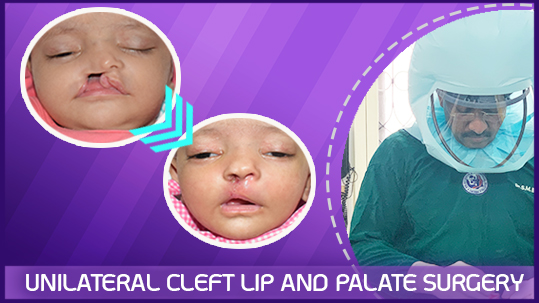
This 3-month-old little girl is from Tenali in Andhra Pradesh, India. She was born with a very wide unilateral cleft lip and palate defect. There was a hole in the roof of the mouth. Upper lip and nose were a part of this deformity.

Alignment of permanent teeth in the cleft region is often affected. Lateral incisors can also be absent. Reconstructive surgery culminates with the placement of dental implants. Board certified cosmetic surgeons perform these surgeries in the west.

This is the second most common birth defect in infants. Her parents were stoic about this and sought guidance about its management. Children with clefts get to lead normal lives with adequate surgical correction.

Parents Conduct Research for Best Cleft Hospital in India

They researched in-depth about the best cleft hospital in India. This led them to meet many facial cosmetic surgeons and facial plastic surgeons. They enrolled in many cleft support groups and traveled for counseling. Convinced by the extensive research, they presented to our hospital for management.

Causes and Research into Occurrence of Cleft Deformities

The etiology of cleft lip and palate defect is very varied. It can arise due to genetic, environmental factors or mutation. Many mothers with cleft deformity give birth to babies with similar presentation.

Sources of heavy electromagnetic radiation are another alleged cause in recent years. Research is ongoing into this and there is no proof yet about this connection.

Center for Cleft Lip and Palate Correction in India

Our hospital is a specialty center for cleft lip and palate surgery. We are a nodal referral center for facial deformity surgery in Asia. Many patients have had facial esthetics restored through our facial trauma surgery.

We have over 30 years experience in cleft lip surgery and cleft palate surgery. Patients from all over the world come for facial cosmetic surgery.

Recognition from International Organizations

Our hospital is an affiliate of the World Craniofacial Foundation of USA. Our hospital has won awards from the International Cleft Lip and Palate Foundation. Many complex craniofacial cleft patients referred by these organisations undergo treatment with us. There is minimal scarring from surgery due to surgical innovations adopted by us.

Initial Presentation and Treatment Planning at our Hospital

Dr SM Balaji, Cleft Lip Surgeon, examined the patient in detail. The minor segment was very low and not visualized. This increased the degree of difficulty.

He explained that the ideal time for cleft lip surgery was 3 months. Cleft palate surgery was at 11 months and cleft alveolus bone grafting at 3-1/2 years of age. The parents of the girl then signed the consent for cleft lip surgery.

Surgical Correction of Cleft Lip Defect

A modified Millard’s technique was the technique of choice for surgery. Scarring is less compared to other techniques. Functional and esthetic results are also better with this technique.

An ambidextrous approach is the optimal technique for best results in this surgery. Our hospital is a pioneer for this approach in India.

Minimal Postoperative Scarring Following Surgery

This surgery, the first in April, was at the height of the Covid-19 pandemic. Dr SM Balaji donned a protective suit with a separate oxygen supply. This suit ensured the surgeon’s comfort throughout the surgery.

It utilized a two fan system. One fan was to blow out exhaled air and the other fan was to bring in fresh oxygen-rich air. All safety precautions were to ensure the protection of patients and other OT personnel. The surgeon remains enclosed within the suit throughout the procedure.

Optimal Results from Cleft Lip Surgery
A C flap was first raised to recreate the nasal sill followed by an M flap to create the floor of nose. Optimal tissue usage ensured that there was no tissue wastage. There was good adaptation of the two halves of the cleft lip. Results were optimal despite the difficult presentation.

Her parents were very happy with the results of the surgery. Postoperative scarring was very minimal by the time of discharge from the hospital. Cleft palate repair will be at the age of 11 months.

Video